
FEMA Structural Drying Guidance – W-13025A
W-13025A structural drying guidance message for mitigation contractors and policyholders.
Hi MITIGATION CONTRACTOR AND/OR POLICYHOLDER,


I’m the flood adjuster for POLICYHOLDER, who asked that I share FEMA’s structural drying guidance with you. Please see the attached FEMA/NFIP Claims Bulletin W-13025A.


💲 IMPORTANT CLAIMS PAYMENT / COMMUNICATION PROCESS – STANDARD FLOOD INSURANCE POLICY (SFIP)

This is a federal SFIP claim, not a typical private insurance loss. The WYO Carrier who services this claim on behalf of the National Flood Insurance Program (NFIP), administered by FEMA/DHS, does not contract with you and will not pay you directly. Your only customer is the insured. Do not submit anything to the carrier. All communications, contracts, estimates, logs, reports, invoices, communications, etc., must go only to the insured and/or to me as the assigned flood adjuster.

• NFIP policies are federal insurance policies, not private policies.
• Coverage terms are set by SFIP,  which is federal regulation.
• Many policies are serviced by private insurers through the Write-Your-Own (WYO) Program, but the federal government ultimately backs the policy and rules.
• Claim handling must follow FEMA rules, bulletins, and the NFIP Claims Manual, which is why guidance like W-13025A controls drying payments.


A few brief notes regarding the purpose of this document in the context of a Standard Flood Insurance Policy (SFIP) claim:


• FEMA Bulletin W-13025A is the primary guidance FEMA uses for structural drying coverage and payment evaluation under the SFIP.
• The bulletin is intended as claims payment guidance, not a restoration contractor “how-to” standard.
• It specifically states that it is not an industry drying standard and is not intended to instruct drying technicians on how to structurally dry a building.
• Rather, the bulletin outlines FEMA’s expectations for when structural drying may be considered payable thru a SFIP flood claim, and how drying charges may be evaluated during the claims process.

• Considerations include items such as square-foot allowances, reasonable equipment duration, and the importance of proper drying logs where mechanical drying equipment is being utilized.
• Even though this document is from 2013, within FEMA’s current framework, the NFIP Claims Manual (June 2025) continues to reference this bulletin within the structural drying appendix as governing claims guidance.


🧰 Below are some of the more important points within the bulletin, along with items that mitigation/restoration contractors sometimes mistakenly assume are payable through an SFIP claim:

• Mechanical drying is generally expected only after tear-out, cleanup, and sanitizing treatment are completed, and FEMA’s guidance states that drying should not be performed prior to full restoration of the HVAC system.
• Where mechanical drying equipment such as dehumidifiers is utilized, proper drying logs are important to document conditions and support the duration of the drying operation.
• Where adequate drying documentation is not maintained, drying is generally evaluated within limited duration guidelines.
• Dehumidification should not be considered in crawlspaces or other areas exposed to soil or outdoor conditions.
• Regarding basements and other lower-level areas, drying consideration remains subject to SFIP coverage limitations, dehumidification expectations may be reduced in unfinished basement or cellar conditions, and payment for drying still depends on proper documentation, reasonable duration, and whether the affected items are covered under the policy.
• Certain charges, such as PPE, air scrubbers, generators, and related labor, are often considered included within demolition, cleanup, or treatment line items rather than separately payable drying charges.


PLEASE NOTE: This is only a brief summary and should not be relied upon as a substitute for the full guidance. FEMA Bulletin W-13025A is attached hereto, along with a couple of graphics provided to help illustrate several of the more important provisions within the bulletin.


Please feel free to reach out if you have any questions as the work progresses.

Chris


Christopher T. Gutshall

Insurance Adjuster

NFIP FCN 0070008289


M 330.437.9168  |  E  gutflood@outlook.com <mailto:gutflood@outlook.com>


Authority & Disclaimer: Field adjusters cannot approve/deny coverage or authorize payment. Final claim decisions are made only by the carrier.

Confidentiality Notice: This email may contain privileged or confidential information intended only for the recipient. If you received it in error, please delete it and notify me.
FloodPath placement
This template supports FloodPath Guide content and can be adapted into insured guidance, adjuster copy-ready messages, or form workflow instructions.
Coverage / License Disclaimer
FloodPath provides general claim communication and documentation guidance only. Field adjusters cannot approve/deny coverage or authorize payment. Final claim decisions are made only by the Carrier. Unauthorized copying, resale, redistribution, or commercial use is prohibited.
Attached W-13025A Resources
Use these as supporting reference materials for structural drying guidance, mitigation discussions, and insured/contractor education.
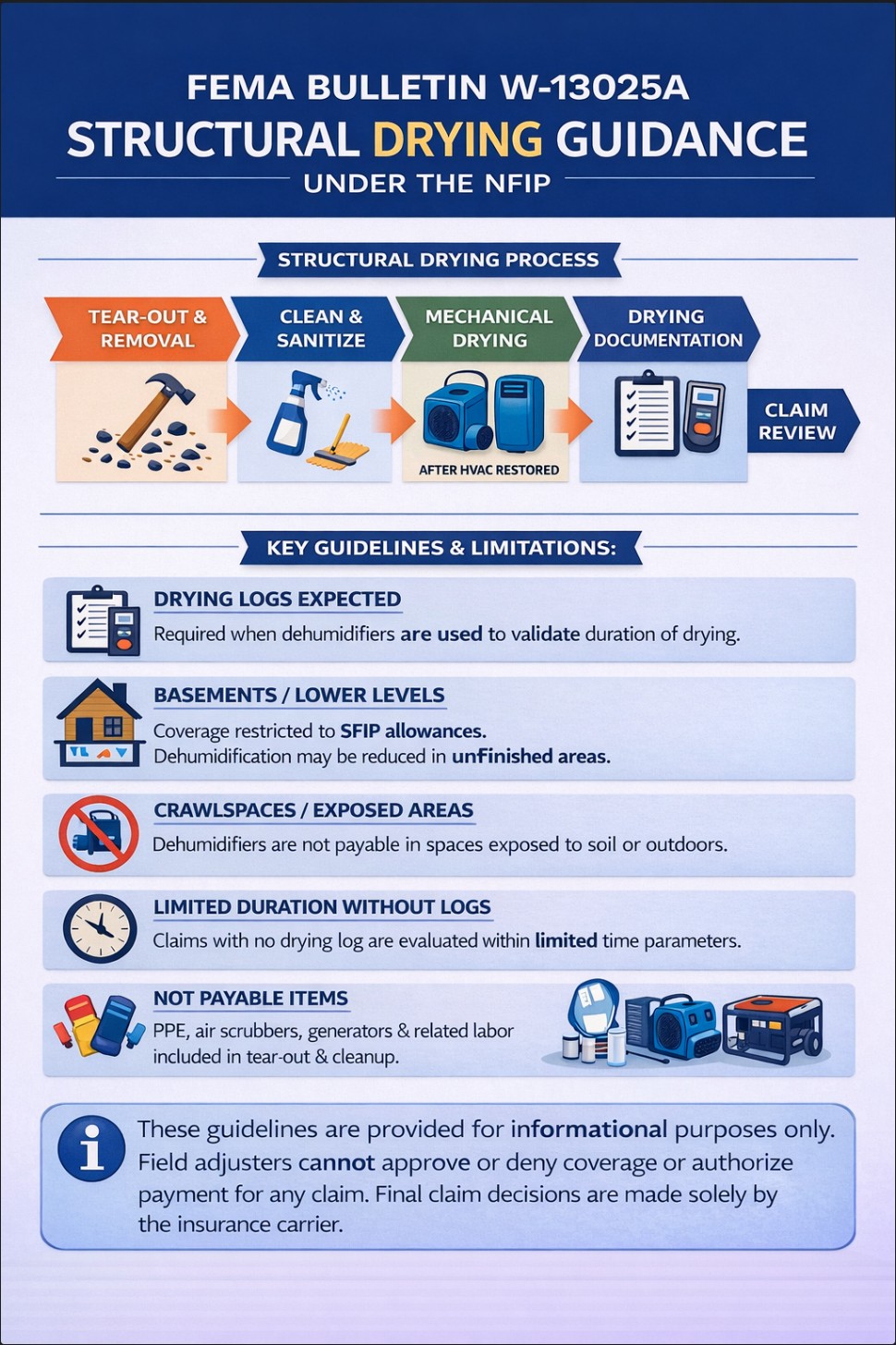
Structural drying process graphic
Summarizes tear-out/removal, cleaning/sanitizing, mechanical drying after HVAC restoration, drying logs, claim review, and common limitations.
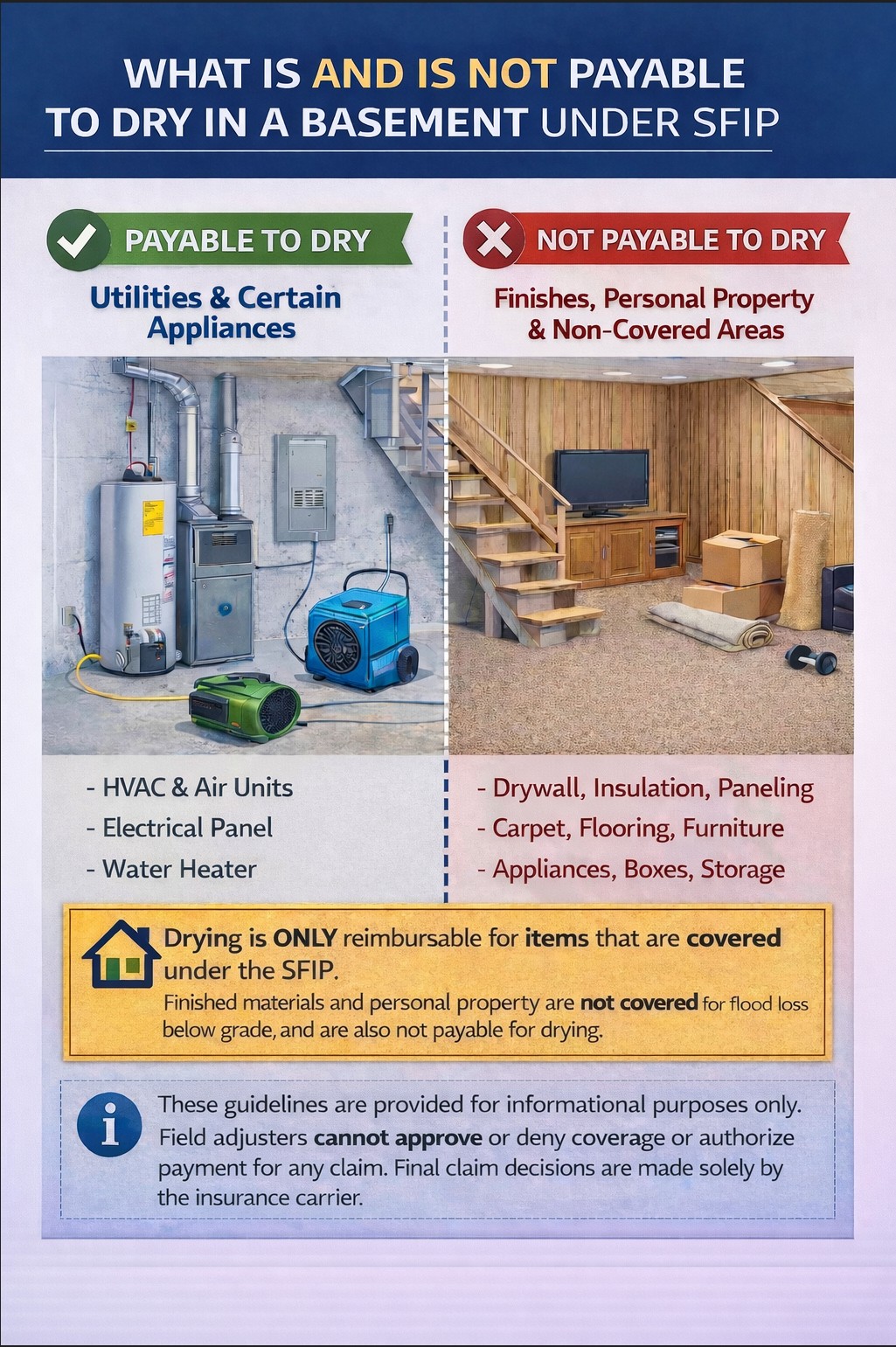
Basement drying payability graphic
Shows the distinction between certain covered utility/appliance items and non-covered basement finishes, personal property, and non-covered areas.